Tuesday, November 25, 2014

Outside Event 2: Disney Historian, Jim Korkis, on Steamboat Willie

Here's Steam Boat Willie itself, I advise watching it after reading what is below...

Earlier this month Disney historian Jim Korkis came to the Walt Disney Family Museum to give a few lectures.  One of them was specifically for volunteers and staff members about Steamboat Willie so I was able to attend.  Steamboat Willie is an important part of Disney history because it was Walt's first major success starring his most popular character Mickey Mouse.  While the short film was made with technology much different to what we use for video now I thought it would be interesting to discuss for this class because it shows how far we have come in less than 100 years.  The black and white cartoon was released on November 18, 1928 and was the opening to the movie Gang War.  It was reported by Jim that the Mickey short actually made A LOT more press than the gangster movie itself, most critics completely ignored the feature film.
Jim's blog states: Variety declared "Steamboat Willie" was “a high order of cartoon ingenuity” and “a peach of a synchronization job all the way.” The New York Times said "Steamboat Willie" was "an ingenious piece of work with a good deal of fun. It growls, whines, squeaks and makes various other sounds that add to its mirthful quality."
Steamboat Willie was the first cartoon to successfully combine sound effects, voice, and music into an animated story with a beloved character still cherished to this day.  Walt always held this cartoon close to his heart and Disney Archivist, Dave Smith stated that when Walt died they found six original drawings from Steamboat Willie still in the bottom drawer of his desk at work.  
Lots of people wonder why this cartoon received the title it did.  It got its name from a movie released earlier that year called Steamboat Bill Jr.  There was no point in changing the "Bill" to "Mickey" because no one really knew who Mickey Mouse was yet... Hard to imagine a time when no one was familiar with that name!!  Steamboat Bill was also the name of the song whistled by Mickey in the short. The lyrics to the song went like this: 
“Steamboat Bill, steaming down the Mississippi.
Steamboat Bill, a mighty man was he.
Steamboat Bill, steaming down the Mississippi.
Out to break the record of the Robert E. Lee.”
At the time Walt and his crew thought the song was in public domain, but turns out it wasn't when they used it. An issue us artists still need to worry about today.

Most of the film was drawn by Ub Iwerks who was known for creating hundreds of drawings a day for Walt early in their careers.  Unlike the two other Mickey Mouse cartoons realeased at this time Ub had a bit of help for this one from Wilfred Jackson and Les Clark.

If you watch the animated short all the way through you will notice that there are several instances where objects disappear when they weren't necessary and reappear again when they are.  These include the rope chord Mickey uses for the boats whistles, the goat's goatee, and some of the instruments around Mickey while he swings the cat in the "Turkey and the Straw" sequence.  This happens because there were so many different frames animators had to repeat over and over.  If something wasn't important might as well not waste their time drawing it, or some small details just got overlooked in the rush of producing the cartoon.  Some of the gags were recycled from Walt's old Oswald the Lucky Rabbit shorts.  Another fun fact is that Walt played the voice of the parrot who teases Mickey throughout the short.  By the end of creating Steamboat Willie it ended up costing Walt $4,986.69.

I thoroughly enjoyed Jim's talk, he has endless amounts of knowledge on subjects I love most.  He has written several books on Disney films and theme parks.  His first one being The Vault of Walt published in 2010.

Monday, November 24, 2014

Outside Event 1: Doug Hall Lecture at SFSU


Link to Doug Hall's official website: http://doughallstudio.com

Not long ago artist Doug Hall came to SFSU to give students and faculty a talk on his past work.  He graduated in Harvard in 1966 and got his MFA in Sculpture.  The opening of his talk was a video piece that was very reminiscent of old slide projectors.  It was a political piece presented as a timeline of photographs with explanations of what was going on at the time in between.  The video focused on the 1960s through 1970s: Martin Luther King, Malcolm X, Richard Nixon, and the coming forth of the gay population.  The video was completely photographs and text with violin music playing in the background.  Doug describes himself as a product of East Coast Suburbia of the 1950s and this perspective comes across in his work.  But in college he became radicalized and involved with the anti war movement as well as Marxist philosophy.
Out of everything he presented, I was most engaged by his MFA project called The Inner Space Modulation Portal.  It was designed as a control station where Doug would live for 7 days in a building at the school.  He described it as a performance piece where he was on a journey of the mind while in one place; he also said that the experience felt a lot like being high on drugs, though he didn't specify what kind.  There was a screen outside of the piece that showed his face inside and he could communicate with those who stood directly in front of it.  My favorite part of this work was the fact that people started to trust him and came down at 3 A.M. to talk to him as if he were some kind of confessional.  When he came out of the machine he described the experience as being reborn as an artist, I found this statement quite beautiful.  His mother was even there for the ceremony.
After Grad school Hall and a couple of his friends started the T.R.U. Collective.  They did more performance pieces such as walking down Mission Street painted entirely white and another called Thirty Two Feet Per Second Per Second where they were attached to a wall about 25 feet high sitting in chairs with cameras and microphones.  
Another video piece that was interesting yet confusing for me to understand was called Really I've Never Done Anything Like this Before where a dual screen of scissors are shown cutting a sleeve revealing the arm within, while the excerpt of a book was read.  He also shared some photographs that I really enjoyed because they made me laugh.  They were called Teaching Old Hats New Tricks and they involved Doug with a bunch of hats in a row on objects that made them look like they were performing circus tricks.
All in all I was really impressed and inspired by all of Doug's work and he is currently working on several projects that he is really excited about.  I will continue to follow his work.

Wednesday, November 19, 2014

MAX Project based on Generation Y

So, lately with my work I've been thinking about trying to evoke a sense of nostalgia.  For our MAX project I want to create a video piece that relates to my own childhood and growing up in front of a screen.  This involved many different types of screens whether it was a television, an arcade video game, or a tiny Tamagotchi pet.  The funny thing is I still spend just as much time in front of screens... even without cable.  Now its my laptop screen or my phone but even retina display.... my eyes hurt.  I want this piece to focus on the time all us Millennials have spent with company's shoving their products into our faces.  Although I don't think this piece will really speak to people who don't consider themselves to be kids of the 1990s, I hope I can still make it fun and interesting.  Our parents grew up watching children's shows like Little House on the Prairie and that was entertaining... enough, I guess?  When you look at that compared to colorful and high intensity cartoons I grew up with it makes sense that so many people in my age group are obsessed with escapism and even surrealist art.  This intrigues me so I want to see where I can take these ideas.

In my research for footage from 90s entertainment I came across this commercial recently released by Microsoft Internet Explorer:


Its really trying to tug on the heart strings of all of us who can remember this era.

Also, I quickly wanted to add that everything I plan on putting in my video still has a life today, only maybe a bit upgraded.  Like Nickelodeon, Lisa Frank, and Chuck E Cheese.

Another big inspiration for this piece is an artist who calls himself Pinky.  I wrote about him in my Conceptual Strategies 1 blog as well.  He makes video compilations made from a ton of old footage he finds in thrift stores.  This includes commercials, workout videos, and sometimes even porn.  Here's an interview of Pinky from TV CARNAGE and examples of his work:

Thursday, November 13, 2014

I Dig These Max Projects

1.  "Glasslands: Tubes" was a project to make nights at the venue easier for lighting technicians.  These tubes allow them to choose from RGB light sequences to choose a theme for whatever show was happening that evening.  Everything for this was built with Max, MSP, and Jitter.

See the explanation for this by DOCTORHANDSHAKE at: https://cycling74.com/project/glasslands-tubes/

2.  Here's a link to my second favorite called "Dag (Fish) is a DJ": https://vimeo.com/72027888
This project is a tribute to the musician Phillip Glass and it is an interactive piece between machine and fish.  As Dag swims in front of the LED screen, it recognizes his movement through video tracking and sounds respond to it.  This creates a live, electronic, experimental music experience.  I enjoy the fact that the artist let go of control for this project and left everything up to this fish.
See further information about Dag and his DJ skills from SYNDROMENU (London based artist) at: https://cycling74.com/project/dag-fish-is-a-dj/

3.  I found "the Vlooper" to be very visually stimulating.  It is a 100% Max Jitter made piece and is a Kinect based Looping Station.  I really liked the way VERTIGO5 played and experimented with the human form for this one.


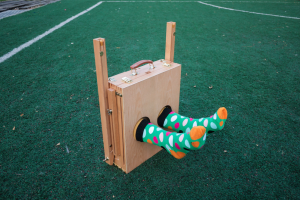
4.  Tickle (Interactive Video Installation) by Liang looks like a really fun project.  It involves fake feet that have been rigged so that when you tickle them Liang huge, projected face on the wall starts laughing.  Here's his explanation on how it all works using MAX:
"I use Max serial to connect with arduino, and with phiscal pressure sensor in the middle of the feet models, and control different videos by if u tickling the center of the feet, the video will change to laugh one , and randomly start from different frame every time u touch the sensor. and i use both usb connection or bluetooth to transfer arduino analog data to Max, thats it !"

Here's what da feets look like:

Here's da feets in place with the rest of dee installation:

I would have loved to see this in person.  It was shown in Beijing, China.  The artist talks about how fast paced the world is now and how he just wanted to experiment with an intimate moment as simple as a tickle.